Getting individual investors into private markets wasn’t the hard part.
The hard part is what comes after.
Portfolio construction across vintage years and asset classes. Liquidity planning when holding periods stretch to fifteen years. Knowing which clients fit which fund (and why) without logging into 75 different portals and building a spreadsheet from scratch.
That’s what institutions have systems for. Individuals don’t. Yet.
Samir Kaji spent 13 years at Silicon Valley Bank and nine at First Republic. Two institutions that built the plumbing of the innovation economy. Both now gone.
What he saw inside them convinced him the infrastructure for responsible individual participation in private markets hadn't been built. So he built it.
Allocate is four and a half years in. Over $4 billion has moved through its pipes across 360 advisor firms and 4,000 individual investors.
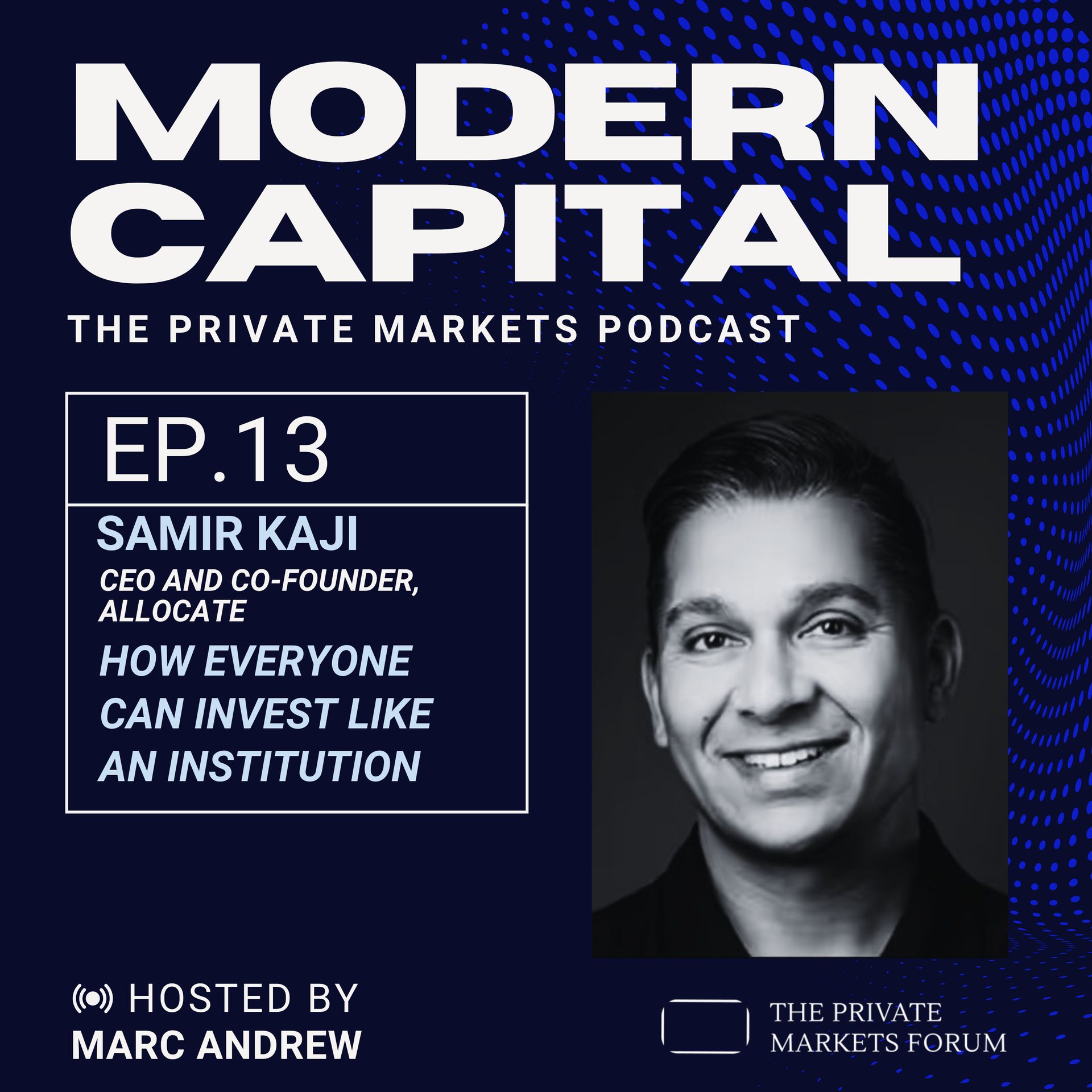
In this episode of the Modern Capital Podcast, Samir and Marc cover:
Why "semi-liquid" isn't the same as liquid, and what actually happens when individuals need out
The barbell: why large funds and emerging managers are playing completely different games, and how to build across both
What institutional portfolio construction actually looks like, and why accredited doesn't mean ready
Where private markets are heading, and who the infrastructure being built right now is actually for
"It's a way to generate alpha, but only if you get it right. So, let's build the system for that."
Private markets are heading past $30 trillion. Getting individuals in was the easy part. This is the conversation about everything that comes next.
Listen to the full conversation here, on Spotify or Apple Podcasts.

The infrastructure Samir describes (liquidity mechanisms, portfolio construction tools, the operational rails connecting private funds to individual investors) is exactly what we’re discussing on May 28 in New York.
The 2026 Private Wealth Infrastructure Summit convenes the fund managers, platform builders and wealth leaders closing the gap between how institutions participate in private markets and how everyone else does.
If that’s your problem, you’ll be among your peers.